

Wertheim
Spessart Tours
Produced by :
© 2025
Produced by :
© 2025
Wertheim is the northernmost town in Baden-Württemberg and lies at the confluence of the Tauber and Main rivers, at the foothills of the Odenwald and Spessart mountains on the other side of the Main. Bordered by the Main to the north, the western part of the municipality, with the Wertheim plateau and the deeply carved valleys of the Main and Tauber rivers, belongs to the Sandstein-Spessart natural region.
On my world tour through the Spessart, Wertheim is the ninth stop, the southern end of the route, which turns north again from here.
It takes a good quarter of an hour, or about 12 km, to drive from the campsite to the city. Follow the bend in the Main river, always along the border between Bavaria and Baden-Württemberg. There is a convenient place to park your car where the Tauber flows into the Main, or you can continue to the Leberklinge car park, from where you can walk across small bridges over the Tauber and past historic buildings directly into the old town. The castle, Wertheim's landmark, is well worth a visit – and for those who want to enjoy the view for longer, there are benches.
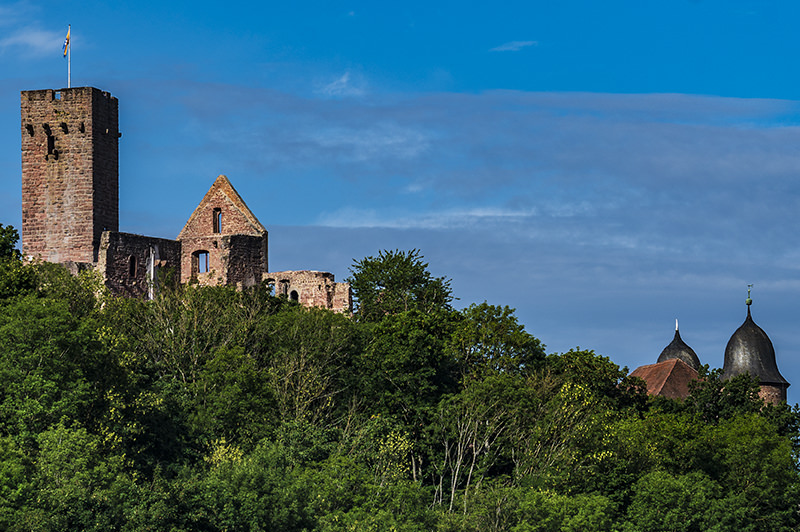
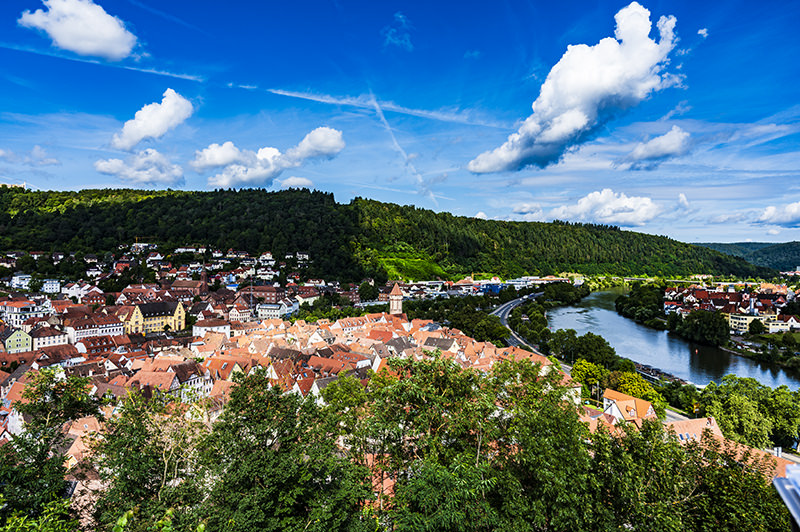
Built in the 12th century, the castle sits enthroned on a mountain ridge above Wertheim between the Main and Tauber rivers. As the seat of the Counts of Wertheim, the castle was continuously expanded until the 17th century. In 1619, it was partially destroyed by a powder explosion and came under heavy fire during the Thirty Years' War, so that today only the ruins of the original castle complex remain. However, it is now one of the most beautiful and largest stone castle ruins in southern Germany. From here, you have a unique view of Wertheim, the rivers and the surrounding area.
The Protestant collegiate church of St. Mary stands in the heart of picturesque Wertheim. In 1384, Count Johann I of Wertheim laid the foundation stone for the late Gothic, three-nave basilica, which is believed to stand on the foundations of two Romanesque predecessor buildings.
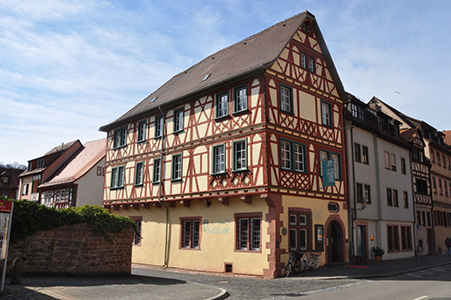
The historic market square is located in the centre of Wertheim's old town. The square is surrounded by richly decorated and wonderfully preserved half-timbered houses, some of which date back to the 16th century. At market square no. 6 is one of the oldest and narrowest houses in Franconia, built around 1520. It's worth taking a closer look! The imaginative and high-quality façade features the region's typical ‘Neidköpfe’ (envy heads), grotesque faces and animal figures, which were intended to ward off evil from the house so that its inhabitants could sleep peacefully and safely.
The Wertheim weekly market takes place every Wednesday and Saturday morning on the market square. The ‘Grüne Markt’ (green market), as it is also known, stands for freshness and regionality, for meeting people, enjoyment and sensory experiences. The market reminds me a little of the weekly markets I have come across in French towns and villages.
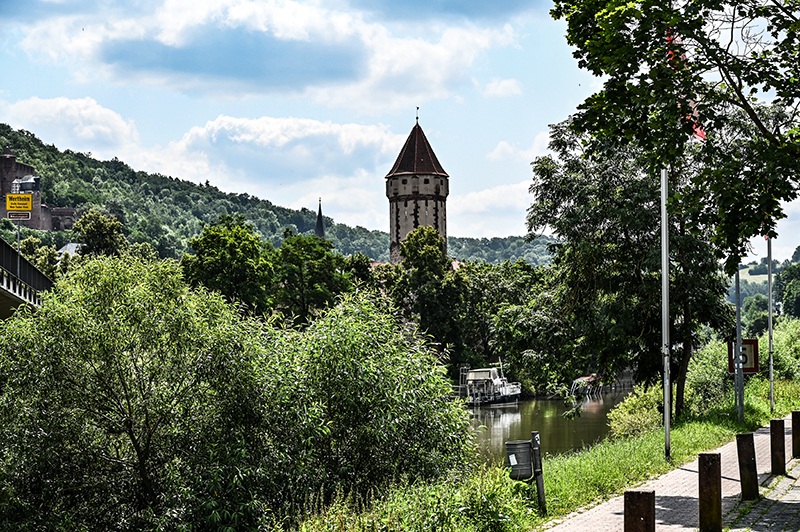
At the confluence of the Tauber and Main rivers, known as the Mainspitze, stands the Spitze Turm (Pointed Tower). 141 steps lead to the top, where you are rewarded with a magnificent view over the roofs of the historic old town and interesting facts about the building.
It was originally a watchtower. Built in the 13th century, it was given an octagonal superstructure in the 15th century to compensate for the slope of the lower structure.
It served as a prison for drunkards and quarrelsome women. Inside, the so-called ‘fear hole’ has been preserved, an opening in the floor at the level of the original entrance, 10 metres above the ground, which could only be reached by ladder. Today, the hole would be called an inspection shaft, but it was probably also used as a psychological means of pressure against the prisoners.
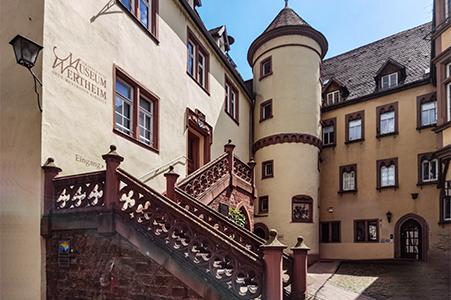
From the Leberklinge car park, you pass the former princely court with the White Tower of the city wall in Mühlenstrasse, which now houses Wertheim Town Hall. In the 17th/18th centuries, the building complex was expanded to serve as the court of the Catholic princely house, with an elaborate Baroque hall. It served as the princely family's residence until 1781, and was then converted into the town hall in the 1970s.
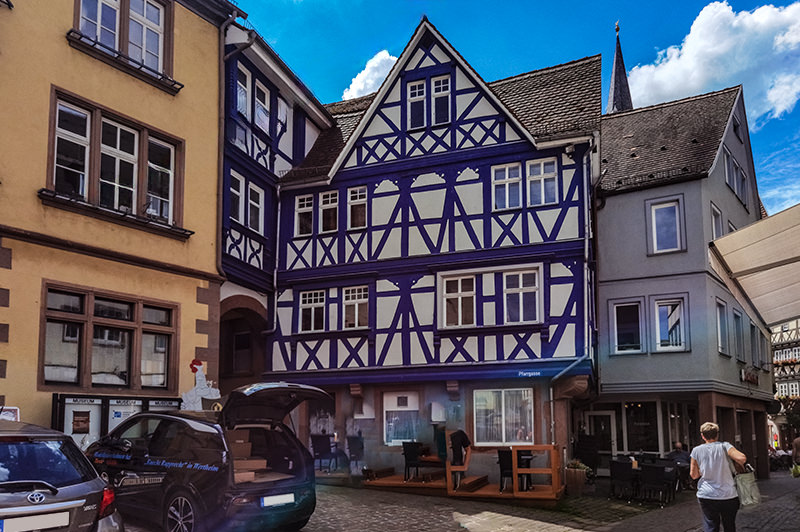
The Blue House is one of the half-timbered houses in Wertheim's old town with blue half-timbering. Smalte, a cobalt-containing glass that is finely ground and used as a pigment, was used to colour the half-timbering blue. It was very expensive to produce and the colour was therefore very precious. The builder was able to stand out from his neighbours and demonstrate his wealth. The blue finish was restored in 1999. Inside the house, an elaborate stucco ceiling has also been preserved.
In Wertheim, the highlights are somewhat hidden and don't immediately catch the eye. You can explore the town in a day... and not really see anything. To really get to know the town, you should take three or four days and immerse yourself in the special features of the town and the surrounding area.